1. How many candidates pass?
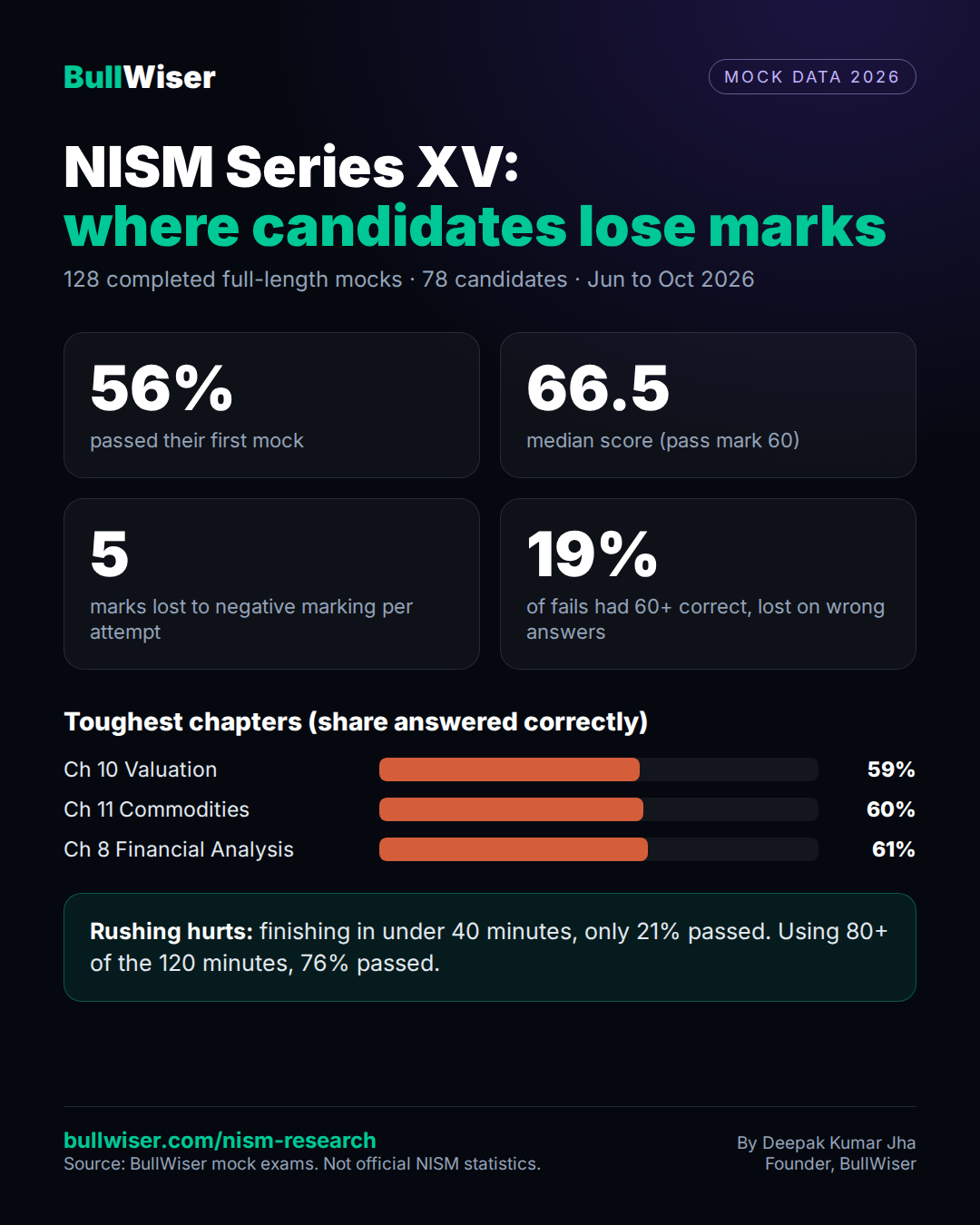
The XV pass mark is 60 out of 100. 56% of candidates scored 60 or more on their first mock. Across all 128 attempts the pass rate was 63%, because candidates who practised more tended to score higher. Scores were spread widely: more than a quarter of attempts scored below 50, while about one in six scored 80 or more.
View as table
| Score band | Attempts | Share |
|---|---|---|
| Below 50 | 36 | 28% |
| 50 to 59 | 11 | 9% |
| 60 to 69 | 33 | 26% |
| 70 to 79 | 28 | 22% |
| 80 and above | 20 | 16% |
2. Negative marking decides close results
NISM XV deducts 0.25 marks for every wrong answer. On average, candidates answered 66.7 questions correctly, 20.1 wrongly and skipped 13.2. Those wrong answers cost about 5 marks per attempt.
With 0.25 deducted per wrong answer, a blind guess between four options gains almost nothing on average (about +0.06 marks) but adds risk. Once you can rule out even one option, guessing pays: with two options left, the average gain is about +0.38 marks per question.
3. The hardest chapters
We counted every question answered in these mocks by chapter: the share answered correctly, wrongly and skipped.
View as table
| Chapter | Marks | Correct | Wrong | Skipped |
|---|---|---|---|---|
| 10 Valuation Principles | 12 | 59.2% | 20.2% | 20.6% |
| 11 Fundamental Analysis of Commodities | 5 | 60.2% | 27.6% | 12.2% |
| 8 Company Analysis: Financial Analysis | 12 | 61.2% | 23.9% | 14.9% |
| 7 Company Analysis: Business and Governance | 6 | 62.5% | 22.4% | 15.1% |
| 13 Qualities of a Good Research Report | 5 | 62.9% | 26.1% | 11.0% |
| 12 Fundamentals of Risk and Return | 7 | 66.1% | 20.9% | 13.0% |
| 9 Corporate Actions | 5 | 66.9% | 21.8% | 11.3% |
| 6 Industry Analysis | 8 | 67.1% | 19.5% | 13.4% |
| 3 Terminology in Equity and Debt Markets | 2 | 69.2% | 21.1% | 9.7% |
| 15 Technical Analysis | 15 | 69.5% | 18.2% | 12.2% |
| 2 Introduction to Securities Market | 2 | 70.3% | 18.8% | 10.8% |
| 5 Economic Analysis | 5 | 70.9% | 20.9% | 8.1% |
| 14 Legal and Regulatory Environment | 10 | 72.1% | 15.0% | 12.9% |
| 4 Fundamentals of Research | 5 | 74.3% | 13.4% | 12.3% |
| 1 Introduction to Research Analyst Profession | 1 | 80.7% | 11.2% | 8.1% |
- Valuation (Ch 10) and Financial Analysis (Ch 8) are the weakest high-weight chapters. Together they carry about 24 marks, yet only about 60% of their questions were answered correctly. Valuation also had the highest skip rate (21%), which points to the numericals: DCF, multiples and cost of capital.
- Commodities (Ch 11) and Research Reports (Ch 13) had the most wrong answers, 28% and 26%. Candidates answered these confidently and got them wrong, which is costly under negative marking.
- Legal and Regulatory Environment (Ch 14) is a strength at 72% correct, even though it carries 10 marks and many candidates worry about it.
4. Candidates who rush fail more often
The exam allows 120 minutes. Candidates who finished in under 40 minutes passed only 21% of the time; those who used 80 minutes or more passed 76% of the time.
Using the time well does not mean reading slowly. It means leaving time to re-check the case-based questions and numericals, where most marks were lost.
5. Practice mocks raise scores
28 candidates took two or more full mocks. Their best score was on average 8.9 marks higher than their first, and wrong answers fell as they practised: negative marks dropped from 5.7 on first attempts to about 2.5 for candidates on their fourth mock or later (a small group of 4 candidates, so treat that last figure as a direction).
What this means for your preparation
- Start with Chapters 8 and 10. They carry about 24 marks and are where candidates are weakest. Practise the formulas until the numericals feel routine.
- Control wrong answers. About 20 wrong answers per paper is common. Answer when you can eliminate at least one option; skip pure guesses when you are already safely above 60.
- Take at least two full mocks under exam conditions, with the 120-minute timer and negative marking on, and review every wrong answer.
- Do not rush. Plan to use at least 80 of the 120 minutes, and keep 15 minutes for the case-based sets.
- Revise Commodities and Research Reports for precision. Candidates often answered these confidently and got them wrong.
Share this infographic
The key findings on one image. Free to share or embed, with credit to BullWiser.
Embed on your site:
Cite this report:
Methodology
Sample: 128 completed attempts by 78 candidates. Abandoned attempts (fewer than 10 correct answers) and staff or test accounts are excluded.
Chapter figures: share of all chapter-tagged questions answered correctly, wrongly or skipped, combined across the 128 attempts (12,800 questions).
Privacy: aggregated and anonymous; no candidate can be identified.
Limitations: these are mock results, not official NISM statistics. Candidates who take mocks may differ from all exam takers, and the sample is modest, so treat small differences between chapters with care.
More reports, as the data grows
We publish a series only once it has enough completed attempts for the numbers to mean something. Current status: